
Last Updated on August 30, 2026 by BIOMEDRIC
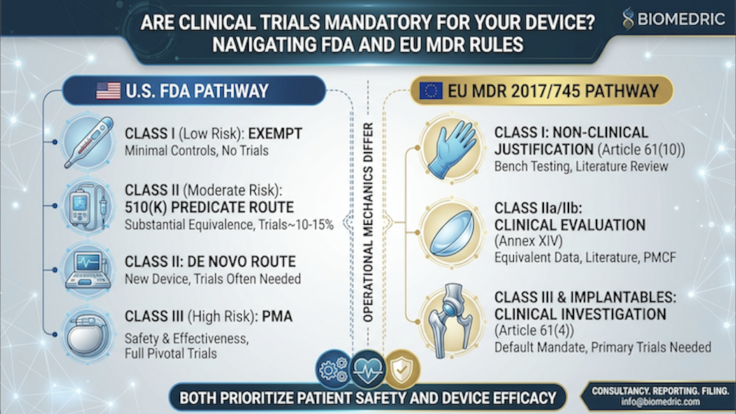
The evolving landscape of medical technology requires a rigorous examination of the regulatory frameworks governing clinical trials and the evidence requirements for medical devices. The U.S. Food and Drug Administration (FDA) and the European Union Medical Device Regulation (EU MDR 2017/745) are pivotal regulatory anchors globally. While both frameworks share the ultimate goal of ensuring device safety and clinical effectiveness, their operational mechanics differ significantly regarding when human clinical trials—known formally as pivotal clinical investigations in the U.S. and clinical investigations in the EU—are mandatory.
Understanding these differences requires distinguishing between generating new primary clinical trial data and performing a comprehensive clinical evaluation.
Regulatory Framework: United States (FDA)
The FDA regulates medical devices under a risk-based tier system (Classes I, II, and III) established by the Federal Food, Drug, and Cosmetic Act (FD&C Act):
- Class I (Low Risk): Most Class I devices (e.g., general surgical instruments, bandages) are exempt from Premarket Notification [510(k)] and Premarket Approval (PMA) under 21 CFR 807. Simple general controls suffice.
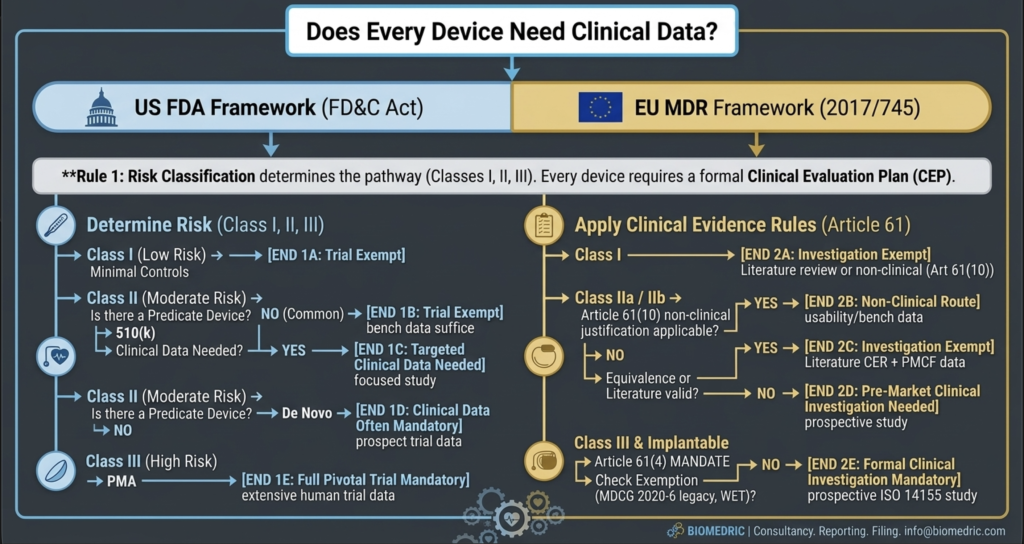
- Class II (Moderate Risk): Typically cleared via the 510(k) pathway by demonstrating “Substantial Equivalence” (SE) to a legally marketed predicate device. While bench performance testing and biocompatibility data are standard, only approximately 10% to 15% of 510(k) submissions require human clinical data. However, for novel moderate-risk devices lacking a predicate, manufacturers must utilize the De Novo Classification Process, which frequently mandates prospective clinical trial data to establish Special Controls.
- Class III (High Risk): Life-sustaining, life-supporting, or high-risk devices (e.g., transcatheter heart valves, implantable pacemakers) require PMA under 21 CFR 814. This pathway almost universally requires prospective, pivotal clinical trial data conducted under an Investigational Device Exemption (IDE) per 21 CFR 812.
Regulatory Framework: European Union (EU MDR 2017/745)
Under the EU MDR, which replaced the legacy Medical Device Directive (MDD 93/42/EEC), clinical evidence expectations were elevated across all device classes (Classes I, IIa, IIb, and III).
Unlike the FDA framework—where a device can be cleared without clinical data if substantial equivalence is met—every medical device placed on the EU market requires a formal Clinical Evaluation Plan (CEP) and Clinical Evaluation Report (CER) per Article 61 and Annex XIV Part A. However, a requirement for a Clinical Evaluation does not automatically mean a Clinical Investigation (trial) must be conducted.
- The Non-Clinical Justification Pathway: MDR Article 61(10) For non-implantable Class I, IIa, or IIb devices that do not make direct clinical claims or perform functions where clinical data is non-applicable (e.g., medical device accessories, surgical instruments, backup hardware), manufacturers can utilize Article 61(10). This clause allows conformity with General Safety and Performance Requirements (GSPRs) to be demonstrated based solely on non-clinical data—including usability testing, bench testing, biocompatibility, and risk management validation. However, as reinforced by Team-NB position papers, Article 61(10) is an exception, not a shortcut: a full CER and literature search strategy are still mandatory to prove that non-clinical testing alone is sufficient under the state of the art.
- Class III & Implantable Mandates vs. Exemptions: Article 61(4) Article 61(4) establishes that Class III and implantable devices must undergo primary clinical investigations. However, explicit regulatory exemptions exist:
- •Demonstrated Equivalence: If the manufacturer has access to the full technical documentation of a predicate/equivalent device under a contractually binding agreement (a strict hurdle under MDR);
- •Well-Established Technologies (WET): Article 61(6b) exempts specific mature implantables (e.g., sutures, staples, dental fillings, screws) from primary clinical trials, provided the CER relies on sufficient literature data;
- •Legacy Devices: Devices previously CE-marked under the MDD can transition to MDR without new clinical trials if historic clinical data, robust Post-Market Surveillance (PMS), and Post-Market Clinical Follow-up (PMCF) meet the “sufficient clinical evidence” hierarchy outlined in MDCG 2020-6.
Innovation vs. Regulatory Burden
The operational divergence between the US and EU frameworks has shifted global commercial strategies.
Historically, medical device developers launched novel products in Europe first due to the MDD’s predictable, literature-based compliance routes. Under the EU MDR, the requirement for clinical data, Notified Body backlogs, and strict equivalence requirements have increased compliance costs and clinical trial burdens—particularly for Small and Medium Enterprises (SMEs).
Conversely, the FDA’s early-stage engagement programs (such as the Q-Submission Program and Breakthrough Devices Program), along with the structured De Novo Process, offer clear preliminary trial design guidance. As a result, many medical technology firms now prioritize FDA submission as their primary clinical launchpad, leveraging US pivotal trial data to subsequently support EU MDR Clinical Evaluation Reports.
Strategic Takeaway for Manufacturers
Clinical trials are not required for all medical devices, but rigorous clinical evaluations are mandatory for all devices entering the European market, and empirical clinical evidence remains the baseline for high-risk FDA clearance.
Navigating this space requires balancing non-clinical bench data, systematic literature appraisals, and prospective clinical trial designs early in the device development lifecycle:
- For US FDA: Evaluate whether bench testing can establish substantial equivalence under a 510(k), or prepare for an IDE trial if pursuing a PMA or De Novo Classification.
- For EU MDR: Establish a clear Clinical Evaluation Plan (CEP) early. Determine whether your technology qualifies for Article 61(10) non-clinical justification, relies on compliant clinical equivalence, or necessitates a prospective PMCF or pre-market Clinical Investigation.
BIOMEDRIC Support for Medical Device Manufacturers
BIOMEDRIC specializes in providing high-end support for all sorts of medical devices and in-vitro diagnostic medical devices regarding the preclinical stage, clinical stage, and post-clinical stage. Whether you want to get FDA and/or EU approval for medical devices or want our consultancy services for medical devices, our specialists would love to know about your requirements for safe practices in the industry.
Not only that, but BIOMEDRIC also provides extensive briefings related to all aspects of medical devices and in-vitro diagnostic medical devices, their types, usage, and the laws. The interface also promotes a user-friendly outlook for assessing the needs and use of the company, with due diligence to the regulations of the FDA and EU.
Please contact us (info@biomedric.com or biomedric@gmail.com) for top-tier consultancy, reporting, and filing services on scientific, technical, and regulatory matters you may need, including Clinical Evaluations (CEP/CER) and Global Clinical Trial Strategy.