
Last Updated on March 25, 2026 by BIOMEDRIC
In an era characterized by rapid technological advancement, the intersection of software and healthcare is increasingly significant. Software as a Medical Device (SaMD) has emerged as a pivotal component in the modern medical landscape, offering innovative solutions that range from diagnostic tools to therapeutic applications. The regulatory frameworks established by the U.S. Food and Drug Administration (FDA) and the European Union Medical Device Regulation (EU MDR) (Regulation (EU) 2017/745) play a crucial role in ensuring the safety and efficacy of these digital health technologies. This article delves into the intricate relationship between SaMD, the FDA, and the EU MDR, outlining the challenges and implications for manufacturers, healthcare providers, and patients.
Defining Software as a Medical Device
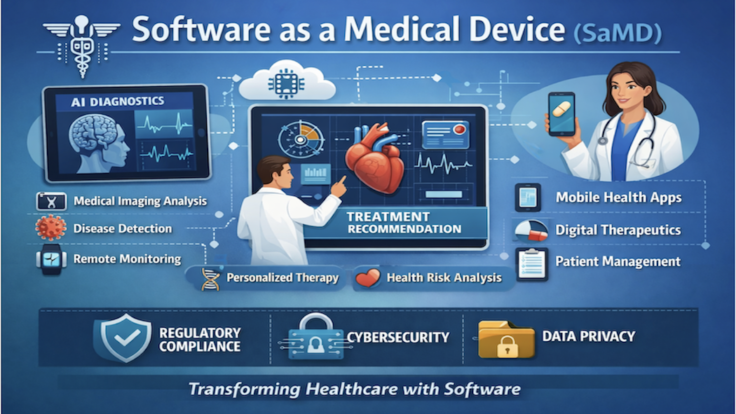
Software as a Medical Device (SaMD) refers to software intended for medical purposes that performs these functions without being part of a hardware medical device. This can encompass a diverse range of applications, including diagnostic tools, treatment planning, patient monitoring, and even software that aids in the management of medical records. Examples of SaMD include mobile applications that analyze health data, algorithms that assist in diagnosing conditions, and software that supports clinical decision-making. As technology evolves, the capabilities of SaMD—which incorporates elements such as artificial intelligence (AI), machine learning, and data analytics—have expanded dramatically, offering the potential to deliver improved patient outcomes, increased operational efficiency, and more personalized care.
Regulatory Landscape: FDA
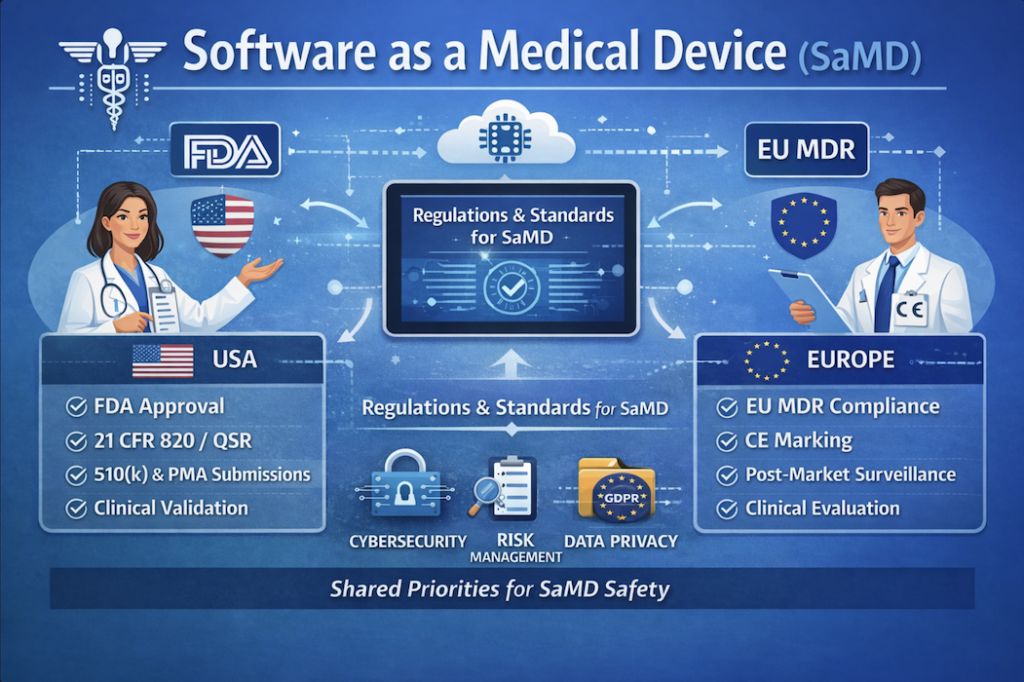
The FDA has established a comprehensive framework for regulating SaMD, aiming to balance innovation with patient safety. The FDA classifies medical devices into three categories: Class I, Class II, and Class III, based on the risk they pose to patients. SaMD can fall into any of these classes, depending on its intended use and the level of risk associated with its operation. For instance, a mobile app that provides general health information may be classified as Class I, while a software application that analyzes medical images for diagnostic purposes may be classified as Class II or III.
The FDA employs a risk-based approach to regulation, which includes premarket notification (510(k)), premarket approval (PMA), and De Novo classification pathways. Each pathway has distinct requirements, with the 510(k) process being the most commonly utilized for SaMD that demonstrates substantial equivalence to an already marketed device. The PMA process, on the other hand, requires rigorous clinical data to demonstrate the safety and effectiveness of high-risk devices. This tiered approach allows for flexibility in regulation while ensuring that SaMD is subject to appropriate scrutiny based on its potential impact on patient health.
FDA guidance specifically addressing SaMD emphasized the need for a clear understanding of the software’s intended use and the context in which it operates. This guidance aims to streamline the regulatory process while ensuring that the software meets safety and effectiveness standards. The FDA’s Digital Health Innovation Action Plan further supports the integration of software into healthcare by promoting the development of regulatory frameworks that foster innovation while maintaining patient safety.
A key aspect of the FDA’s regulatory framework is the emphasis on post-market surveillance and real-world evidence. The agency encourages manufacturers to collect data on the performance of their software once it is deployed, allowing for ongoing assessment of its safety and effectiveness. This iterative approach not only enhances patient safety but also provides valuable insights that can inform future iterations of the software.
Regulatory Landscape: EU MDR (Regulation (EU) 2017/745)
The EU Medical Device Regulation (MDR), representing a significant overhaul of the previous Medical Device Directive (MDD), introduced more stringent requirements for medical devices, including SaMD. The EU MDR emphasizes a lifecycle approach to regulation, requiring continuous monitoring of devices post-market. Under this regulation, SaMD must undergo a conformity assessment to ensure compliance with essential safety and performance requirements. Similar to the FDA’s framework, the classification system in the EU MDR is risk-based, categorizing SaMD into Class I, Class IIa, Class IIb, and Class III.
One of the significant changes brought about by the EU MDR is the increased emphasis on clinical evaluations and post-market surveillance. Manufacturers are now required to provide comprehensive clinical data demonstrating the safety and performance of their SaMD, even for devices that were previously exempt from such requirements. This heightened scrutiny aims to enhance patient safety and ensure that SaMD remains effective throughout its lifecycle.
Cybersecurity
Cybersecurity considerations are paramount in both the FDA and EU regulatory frameworks. The increasing interconnectedness of medical devices and health information systems creates a fertile ground for cyber threats. The FDA has issued guidance documents outlining the importance of cybersecurity throughout the device lifecycle, encouraging manufacturers to implement risk management strategies that address potential vulnerabilities. Similarly, the EU MDR highlights the need for risk assessments that encompass cybersecurity threats, emphasizing that manufacturers must adopt a proactive approach to mitigate risks associated with unauthorized access and data breaches.
As healthcare increasingly relies on digital solutions, the intersection of SaMD, cybersecurity, and regulatory compliance becomes increasingly intricate. The stakes are high: a breach in cybersecurity can not only compromise sensitive patient information but also undermine trust in digital health solutions. To navigate this complex landscape, stakeholders—including manufacturers, healthcare providers, and regulatory bodies—must collaborate to establish best practices that ensure the safety and efficacy of SaMD.
Challenges and Implications
The convergence of SaMD with regulatory frameworks presents unique challenges for manufacturers. Rapid technological advancements often outpace the capabilities of regulatory bodies, leading to a lag in guidance and standards. This disparity can create uncertainty for developers regarding compliance pathways, especially for innovative products that leverage AI and machine learning.
Moreover, the global nature of the medical device market complicates regulatory adherence. Manufacturers must navigate differing requirements between the FDA and EU MDR, which can be resource-intensive and time-consuming. The potential for divergent regulatory pathways may also stifle innovation, as companies may opt to limit their product offerings to avoid the complexities of multiple regulatory landscapes.
For healthcare providers, the integration of SaMD into clinical practice raises questions about the reliability and interpretability of software-generated outputs. As the reliance on digital tools grows, there is an increasing need for robust training and education to ensure that healthcare professionals can effectively utilize these technologies while maintaining patient safety.
In conclusion, Software as a Medical Device (SaMD) stands at the forefront of healthcare innovation, with the potential to transform patient care through improved diagnostics, treatment options, and personalized health management. The regulatory frameworks established by the FDA and EU MDR play a vital role in shaping the development and deployment of SaMD, balancing the need for innovation with the imperative of patient safety. As technology continues to advance, ongoing dialogue among stakeholders—including regulators, manufacturers, and healthcare providers—will be essential to navigate the complexities of this dynamic field, ensuring that the benefits of SaMD are realized while minimizing risks to patients. In this evolving landscape, the collaboration between technological advancement and regulatory oversight will ultimately define the future of healthcare delivery in the digital age.
BIOMEDRIC Support for Medical Device Manufacturers
BIOMEDRIC specializes in providing high-end support for all sorts of medical devices and in-vitro diagnostic medical devices regarding the preclinical stage, clinical stage, and post-clinical stage. Whether you want to get FDA and/or EU approval for medical devices or want our consultancy services for medical devices, our specialists would love to know about your requirements for safe practices in the industry.
Not only this, but BIOMEDRIC also gives extensive briefings related to all aspects of medical devices and in-vitro diagnostic medical devices, their types, usage, and the laws. The interface also promotes a user-friendly outlook to assessing the needs and use of the company, with due diligence to the regulations of the FDA and EU.
Please contact us (info@biomedric.com or biomedric@gmail.com) for the top-tier consultancy, reporting, and filing services on scientific, technical, and regulatory matters you may need, including Software as a Medical Device.