
Last Updated on October 7, 2026 by BIOMEDRIC
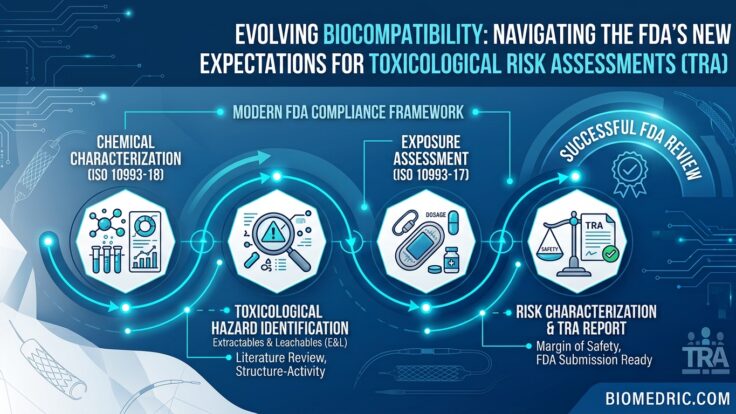
The regulatory landscape for medical devices has officially broken ties with the historical, checklist-based approach to biocompatibility. Driven by the U.S. Food and Drug Administration’s (FDA) recent recognition updates—including the adoption of the updated ISO 10993-17:2023 and the partial recognition of the new ISO 10993-1:2025—manufacturers face a highly scrutinized, risk-based ecosystem.
Biocompatibility is no longer just a box to tick before a 510(k) or PMA submission. Today, the FDA expects a robust, mathematically sound narrative that connects material characterization directly to patient safety. At the heart of this shift is the Toxicological Risk Assessment (TRA).
For medical device manufacturers, understanding these updated expectations is critical to avoiding costly Additional Information (AI) requests, deficiencies, and submission delays.
The Core Shift: From General Testing to Targeted Risk Estimation
Historically, if a device had long-term contact with the human body, the default path was expensive and time-consuming in vivo (animal) testing. The FDA’s updated stance explicitly prioritizes chemical characterization (ISO 10993-18) and toxicological risk assessments (ISO 10993-17) to minimize unnecessary animal testing wherever scientifically justifiable.
However, this flexibility comes with increased rigor. FDA reviewers are rejecting generalized or poorly structured TRAs. The agency expects a transparent, reproducible, and standardized mathematical framework for every single chemical constituent identified in your extractable and leachable (E&L) studies.
4 Pillars of the FDA’s New TRA Expectations
If you are preparing a regulatory dossier, your TRA must align with the exact methodologies formalized in the latest ISO 10993-17 guidelines. Here are the key pillars the FDA heavily scrutinizes:
1. The Use of Toxicological Screening Limits (TSL)
One of the most significant and helpful additions to the toxicological framework is the Toxicological Screening Limit (TSL). The TSL is a scientifically calculated threshold below which a chemical constituent presents negligible risk to the patient (excluding specific high-concern endpoints like carcinogenicity or irritation).
- The FDA Expectation: Reviewers accept the TSL to screen out low-risk compounds early in the process, allowing toxicologists to focus resources on high-risk constituents. However, to use a TSL, manufacturers must establish the Total Quantity (TQ) of the chemical available in the device through exhaustive or worst-case extraction data.
2. Precise Calculation of EEDmax (Worst-Case Exposure)
The FDA no longer accepts vague assumptions regarding patient exposure. You must calculate the Worst-Case Estimated Exposure Dose (EEDmax). This metric shifts the focus from what chemicals could leach out in a laboratory to what a patient is realistically or conservatively exposed to during clinical use.
- The FDA Expectation: The EEDmax must factor in precise patient contact duration, clinical application, and device surface area. If a device has an intermittent contact profile, the release kinetics and cumulative exposure must be meticulously detailed rather than averaged out over a lifespan.
3. Clear Derivation of Tolerable Intake (TI) and Tolerable Contact Level (TCL)
The outdated concept of “allowable limits” has been completely removed from the lexicon. Instead, the FDA requires the derivation of Tolerable Intake (TI) for systemic effects and Tolerable Contact Level (TCL) for local tissue effects.
- The FDA Expectation: Your TRA must clearly document the toxicological point of departure (PoD), such as a No Observed Adverse Effect Level (NOAEL), sourced from reputable databases. Toxicologists must explicitly state the uncertainty factors (e.g., inter-species and intra-species variability) applied to calculate the final TI or TCL.
4. A Definitive Margin of Safety (MOS)
The ultimate conclusion of any TRA rests on the Margin of Safety (MOS) calculation, determined by dividing the TI by the EEDmax.
- The FDA Expectation: An MOS ≥ 1 indicates the risk is acceptable. If the MOS < 1, the FDA will flag it immediately as a deficiency. Under the current guidelines, if your MOS drops below 1, you cannot simply declare the device “safe based on historical use”. You must provide additional biological data, execute specialized subacute/subchronic testing, or perform a highly refined release kinetics study to prove the real-world exposure is safe.
Common Red Flags That Trigger FDA Deficiencies
Even highly experienced Ar-Ge and quality teams fall into regulatory traps when drafting TRAs. The most common issues triggering FDA AI requests include:
- Inadequate Analytical Evaluation Thresholds (AET): Setting the AET too high during ISO 10993-18 chemical characterization, which causes low-concentration but highly toxic compounds to be missed entirely.
- Lack of Specialized Extrapolations for Long-Term Use: For permanent implants or continuous exposure devices exceeding 30 days, the FDA expects an additional safety factor of 10 when relying on short-term toxicological studies to account for potential cumulative chronic toxicity.
- Ignoring Local Tissue Effects: Focusing entirely on systemic toxicity while neglecting to calculate the TCL for devices contacting highly sensitive tissues, leading to immediate pushback regarding irritation or mucosal safety.
Strategic Recommendations for Device Manufacturers
To ensure your regulatory submission passes FDA scrutiny seamlessly, integrate these steps into your product development lifecycle:
| Strategic Step | Action Plan | Benefit |
| Early Chemical Screening | Execute chemical characterization early in the design phase to identify potential material risks before locking in suppliers. | Prevents costly re-engineering late in the project. |
| Apply the TSL Framework | Utilize the TSL method to screen out benign compounds, leaving only high-concern chemicals for full toxicological profiling. | Reduces TRA drafting time and complexity by up to 90%. |
| Leverage Release Kinetics | If exhaustive extraction shows high chemical levels, utilize sequential extraction to map out actual chemical release over time. | Generates a realistic, lower EEDmax to rescue borderline MOS scores. |
Conclusion: The Importance of Expert Regulatory Strategy
Navigating the intersection of ISO 10993-17:2023 and the FDA’s evolving risk-based enforcement requires deep toxicological expertise paired with sharp regulatory foresight. A poorly justified TRA can derail an entire 510(k) timeline, costing hundreds of thousands of dollars in delayed market entry.
Building a seamless biological evaluation plan (BEP), identifying exact extractable profiles, and translating data into a high-tier Toxicological Risk Assessment report (BER / TRA) is the only definitive way to satisfy modern FDA reviewers. By treating biological safety as a continuous risk management process rather than a final testing hurdle, manufacturers can secure faster approvals and safeguard patient health.
BIOMEDRIC Support for Medical Device Manufacturers
BIOMEDRIC specializes in providing high-end support for all sorts of medical devices and in-vitro diagnostic medical devices regarding the preclinical stage, clinical stage, and post-clinical stage. Whether you want to get FDA and/or EU approval for medical devices or want our consultancy services for medical devices, our specialists would love to know about your requirements for safe practices in the industry.
Not only that, but BIOMEDRIC also provides extensive briefings related to all aspects of medical devices and in-vitro diagnostic medical devices, their types, usage, and the laws. The interface also promotes a user-friendly outlook for assessing the needs and use of the company, with due diligence to the regulations of the FDA and EU.
Please contact us (info@biomedric.com or biomedric@gmail.com) for top-tier consultancy, reporting, and filing services on scientific, technical, and regulatory matters you may need, including the FDA’s New Expectations for Toxicological Risk Assessments.